Spatial Analysis of The Distribution of Drug Abuse Cases in East Java Province, Indonesia 2019-2023
DOI:
https://doi.org/10.5281/zenodo.18147147Keywords:
Drug abuse, Spatial autocorrelation, Moran’s I, Socioeconomic factors, East Java ProvinceAbstract
Background: The high rate of drug abuse in East Java Province indicates a complex socioeconomic issues that are region-based. This can be seen from the uneven distribution of drug abuse cases, which is thought to be influenced by regional socioeconomic conditions. A spatial approach, specifically spatial autocorrelation analysis, is needed to identify clustering patterns and interregional connections. Objective of this study to identify the areas in East Java with the highest risk of drug abuse rates from 2019 to 2023. Methods: This is an observational study with a cross-sectional design using spatial autocorrelation analysis. The population and sample consist of 38 regencies/cities in East Java Province from 2019 to 2023, with a total sampling technique. Results: There was spatial autocorrelation in drug abuse cases with positive and significant Moran's I value over five years. There was spatial autocorrelation in the variables of minimum wage, crime rate, and open unemployment rate in relation to drug abuse cases with positive and significant Moran's I value over five years. Conclusion: There is spatial autocorrelation in the variables of minimum wage in regencies/cities, crime rates, and open unemployment rates in relation to drug abuse cases in East Java Province from 2019 to 2023. Conclusion: the results of this study can be used as a basis for policy formulation focusing on areas with high wages, high crime rates, and high unemployment rates regarding region-based drug abuse interventions so that integrated interventions can be carried out.
Downloads
References
Achmadi. 2008. Manajemen Pernyakit Berbasis Wilayah. Jakarta: UI-Press.
Adam S. (2012). Dampak Narkotika pada Psikologi dan Kesehatan Masyarakat. J Health and Sport. Vol 5 No 2.
Aisyah, Fatia Nur (2024) Strategi Badan Narkotika Nasional Dalam Pencegahan Penyalahgunaan Narkoba di Kota Surabaya. Undergraduate thesis, UPN Veteran Jawa Timur.
Arief, B. (2022). Ketimpangan Sosial dan Kejahatan Narkoba di Perkotaan. Jurnal Kriminologi Indonesia, 18(2), 101–115
Azmiyati, SR, dkk. 2014. Gambaran Penggunaan NAPZA Pada Anak Jalanan Di Kota Semarang.
Badan Narkotika Nasional (BNN). (2024). Pemetaan Potensi Kawasan Rawan Narkoba di Provinsi Jawa Timur. Diakses dari bnn.go.id.
BNN. 2024. Indonesia Drug Report 2024. Pusat Penelitian, Data, dan Informasi Badan Narkotika Nasional Republik Indonesia. Vol. 6 ISSN: 3047-762X
Budiartha & Anggraini. 2024. Analisis Pengaruh Indeks Pembangunan Manusia (IPM), Ketimpangan Pendapatan dan Pertumbuhan Ekonomi terhadap Tingkat Kriminalitas di Indonesia. Jurnal Pendidikan Indonesia 5(11).
Choi, J. I., Lee, J., Yeh, A. B., Lan, Q., & Kang, H. (2022). Spatial clustering of heroin-related overdose incidents: a case study in Cincinnati, Ohio. BMC public health, 22(1), 1253. https://doi.org/10.1186/s12889-022-13557-3
Cromley, E. K., & McLafferty, S. L. (2012). GIS and Public Health. Guilford Press.
Dewabrata, W. (2023). Mental Health, Environmental, and Socioeconomic Geographic Factors of Severe Drug Addiction: Analysis of Rehabilitation Center Data in Indonesia. Substance abuse: research and treatment, 17, 11782218231203687.
Hendri & Muharja. 2014. “Kriminalitas: Sebuah Sisi Gelap dari Ketimpangan Distribusi Pendapatan”. Jurnal Ekonomi dan Kebijakan Publik, Vol.5, No.2, h..239-252. Diakses tanggal 7 Mei 2024, dari https://www.academia.edu/download/38146077/Luar_Davy_Krimi nalitas_22_Desember_2014-rev_2.pdf
Isnaini, F., Tjiptoherijanto, P., & Nugroho, S. (2018). Spatial analysis on the impact of socioeconomic vulnerability to drug abuse prevalence in Indonesia, 2015 (Working paper/Manuscript). https://www.researchgate.net/publication /328350177_Spatial_analysis_on_the_impact_of_socioeconomic_vulnerability_to_drug_abuse_prevalence_in_Indonesia_2015.pdf
Isnaini. 2020. Sistem Informasi Geografis (SIG) Untuk Pemetaan Penyalahgunaan Narkoba Menggunakan Analisis Korelasi Spasial di Provinsi Sumatera Utara. Jurnal Pertahanan Vol 6. No. 3, 416-428.
Istiqlala, D. R., & Fahmi, M. A. (2024). Pola Sebaran Stunting di Kabupaten Jombang Tahun 2023 Menggunakan Analisis Geospasial. Ficco Public Health Journal, 1(02), 34-41. https://doi.org/10.5281/zenodo.14560886
Istiqlala, D. R. (2024). Pemetaan Kejadian Kasus Demam Berdarah Dengue di Kabupaten Kediri Tahun 2023. Ficco Public Health Journal, 1(02), 49-52.
https://doi.org/10.5281/zenodo.14561193
Lasri, Andi. (2018). Penyalahgunaan Zat Adiktif Di Kalangan Remaja (Studi Kasus Di Desa Batang Kecamatan Taka Bonerate Kabupaten Kepulauan Selayar). Skripsi FKIP Universitas Muhammadiyah Makassar.
Marotta, P. L., Hunt, T., Gilbert, L., Wu, E., Goddard-Eckrich, D., & El-Bassel, N. (2019). Assessing Spatial Relationships between Prescription Drugs, Race, and Overdose in New York State from 2013 to 2015. Journal of psychoactive drugs, 51(4), 360–370.
Mubarok & Saepudin. (2023). Analisis Pengaruh Indikator Sosial Ekonomi Terhadap Tingkat Kriminalitas: Studi Pada 13 Kota Besar di Indonesia 2015-2021. Jurnal Riset Ilmu Ekonomi, 3(2), 101–117
Mufida, A. A. (2024). Pemetaan Hasil Kredensial Tenaga Kesehatan Berbasis Sistem Informasi Geografis di Kabupaten Kediri. Ficco Public Health Journal, 1(02), 53-56. https://doi.org/10.5281/zenodo.14561221
Mufida, A. A., & Fahmi, M. A. (2024). Pemetaan Kasus Stunting di Kabupaten Lamongan Tahun 2023. Ficco Public Health Journal, 1(02), 42-48.
https://doi.org/10.5281/zenodo.14561145
Phlicharoenphon, W., & Pummakarnchana Robert, O. (2024). Applying spatial statistical analysis to narcotics litigation in Muang Nakorn Pathom, Nakorn Pathom Province. Journal of Science and Technology, Mahasarakham University, 43(2), 97-107.
Pina. 2015. Dukungan Pemerintah Dalam Mencegah Penyalahgunaan Narkoba Di Kota Surabaya. Universitas Airlangga. Jurnal Promkes, 3(2), 171-182.
Puslitdatin BNN. 2023. Laporan Hasil Pengukuran Prevalensi Penyalahgunaan Narkoba Tahun 2023. https://puslitdatin.bnn.go.id/konten/unggahan/2024/03/Hasil-Surnas-Lahgun-Narkoba-2023.pdf
Rahman dkk. 2021. Pola Spasial Kriminalitas Narkoba di Kota Kendari. Jurnal Perencanaan Wilayah PPS UHO Vol.6., No.2, hal 164-170.
Sitinjak & Ghuzini. 2023. Spatial Analysis of Youth Unemployment in Indonesia: Minimum Wages and Industrial Mix. Gadjah Mada Economics Working Paper Series 202308008, Department of Economics, Faculty of Economics and Business, Universitas Gadjah Mada.
Sulastiana, S. (2024). Shifts in geographical preference for illegal production and distribution of synthetic narcotics in Indonesia. Cogent Social Sciences, 10(1), 2289602. https://doi.org/10.1080/23311886.2023.2289602
Supriadi dkk. 2022. Penentuan Daerah Rawan Penyalahgunaan Narkoba Di Kota Bandar Lampung Menggunakan Sistem Informasi Geografis (SIG). Universitas Lampung: Jurnal Penelitian Geografi Volume 1 No. 1, 1-14.
Tribratanews. 2025. Polda Jatim berhasil ungkap jaringan narkoba internasional, 21 kg sabu senilai Rp 22 miliar disita. Tribratanews Sulut Polri. Diakses dari https://tribratanews.sulut.polri.go.id/polda-jatim-berhasil-ungkap-jaringan-narkoba-internasional-21-kg-sabu-senilai-22-milyar-disita/
Wahyuni et al. (2021). Integration of Spatial Analysis in Criminal Mapping: A Case Study in Central Java. Indonesian Journal of Geography, 18(2), 97-105.
Yusuf Bilal. (2024). Pengaruh Pendidikan, Pengangguran, Kepadatan Penduduk, Kemiskinan, dan Penyalahgunaan Narkoba Terhadap Kriminalitas di 10 Provinsi Indonesia. Skripsi, Universitas Islam Negeri Syarif Hidayatullah Jakarta.
More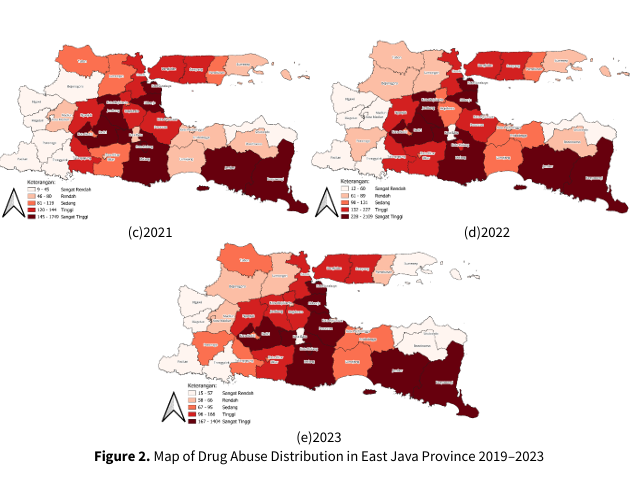
Downloads
Published
Issue
Section
License
Copyright (c) 2025 Pinda Duana Wahyu Purwantaris, Mohamad Anis Fahmi (Author)

This work is licensed under a Creative Commons Attribution 4.0 International License.